

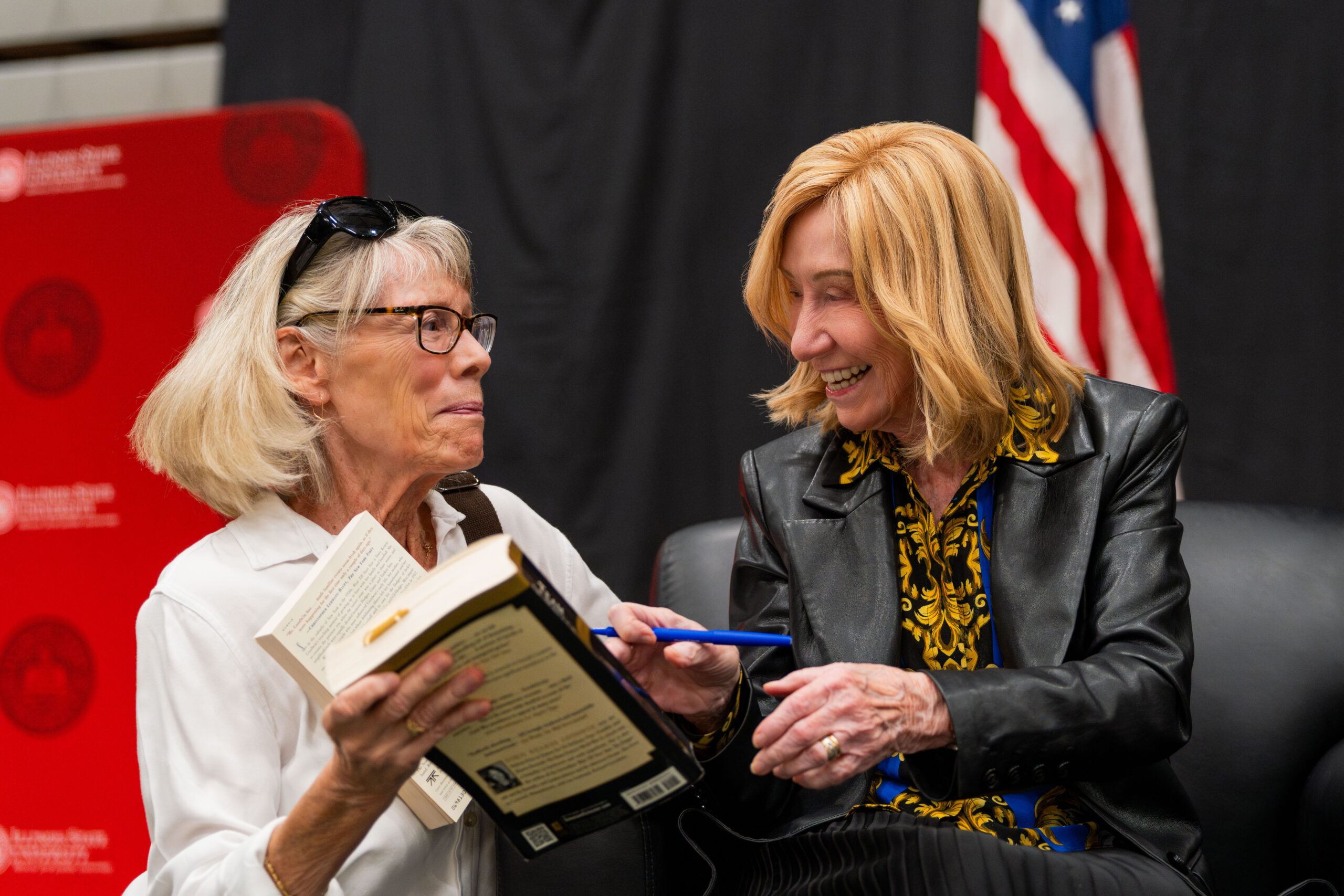
“I don’t say this often, but I’m nervous,” President Sheanon Zenger said on Monday, Oct. 6, 2025, to a crowd of more than 1,000 at the Shirk Center.
Zenger had the difficult task of introducing Doris Kearns Goodwin before her discussion with Illinois Wesleyan professor William Monroe for the Adlai E. Stevenson Memorial Lecture Series.
But at 82 years old, Goodwin’s list of accomplishments would be a lot easier to recap by covering the few things she hasn’t accomplished over 50 years of work.
Zenger still tried to cover all the bases. Goodwin is a Pulitzer Prize-winning author, a former White House Fellow, a graduate of Colby College and a student and professor at Harvard University. She’s a partner at Pastimes Productions, a grandmother and a Boston Red Sox fan.
But in one word, Goodwin is a historian—a damn good one.
Her focus has been devoting her life to chronicling and writing about the lives of four U.S. presidents: Lyndon B. Johnson , Abraham Lincoln, John F. Kennedy and Theodore Roosevelt.
But Goodwin’s path to becoming a world-renowned presidential historian began in an unconventional way. It started with baseball.
“When I was only six years old, my father taught me that mysterious art of keeping score while listening to baseball games, so when he went to work in New York during the day, I could record for him the history of that afternoon’s Brooklyn Dodgers game,” Goodwin said.
“He would come home at night, and then I could recount for him every play of every inning. It made me feel there’s something magical about history,” she said.
She also credited an old history teacher of hers for starting her fascination with presidents.
“She talked to us about leaders, but she kept telling stories about them, and she made them come alive before us,” Goodwin said. “She loved Lincoln most of all. When she talked to us about Lincoln dying, she actually cried.”
In college, Goodwin got the opportunity to work in Washington, D.C., the summer of 1963 for the State Department, an internship that would change her life.
“I thought I wanted to study international relations,” Goodwin said. “I had studied eight years of French and Russian and the government.”
But that summer, the March on Washington changed her focus from international to American relations.
“To be at that march was to be at something really special. It was the first time I felt that I was part of something larger than myself, that I felt maybe I could make a difference,” Goodwin said.
In the spring of her senior year, Goodwin received a full scholarship to attend graduate school in Paris and Brussels. Her Colby College commencement speaker, Adlai Stevenson—an Illinois Wesleyan alum and the namesake for the speaker series Goodwin participated in—spoke about the civil rights movement and said, “I hope that all of you will want to be part of the burning issues of the day.”
Stevenson’s speech was so moving that Goodwin turned down the scholarship and stayed in America. She attended Harvard University for grad school and was later selected to be a White House fellow, a prestigious program allowing students to work and learn at the highest levels of the federal government. She attended a ball where she danced with President Lyndon B. Johnson, who then personally told her he wanted her assigned to work with him.
Was the offer too good to be true? Goodwin was nervous, and rightfully so. In the months leading up to Goodwin’s selection as a White House fellow, she wrote an article against LBJ and against American involvement in the Vietnam War. It was published shortly after she was selected as a fellow. Unbeknownst to Goodwin, the FBI did a formal investigation into her. A late-night discussion between LBJ and Senator Richard B. Russell Jr. had one topic: what to do about Doris Kearns?
Lyndon B. Johnson decided that Goodwin would be assigned to him. He felt that if he brought her down to D.C. for one year, he could win her over.
Winning her over was an understatement. Over the next decade, Goodwin worked with LBJ as both a White House fellow and as his memoirist. During her talk, Goodwin shared stories of her time with LBJ, including a time she was nervous he was going to confess love to her at Lake LBJ. He treated her to cheese and wine and ended the night by saying she reminded him of his mother.
Goodwin’s first book on LBJ, “Lyndon Johnson and the American Dream,” became a national bestseller and achieved critical acclaim. After that Goodwin thought, “Why not another president?” So, she began studying John F. Kennedy. After him, FDR and Eleanor Roosevelt. then Lincoln, then Teddy Roosevelt.
Fifty years later, she is now one of the greatest presidential historians of all time.
Goodwin dove into story after story about the personal lives of the Roosevelts, Lincoln and JFK, speaking with the familiarity of one discussing an old childhood friend they once loved dearly but no longer see anymore—as if Goodwin herself went to Lincoln’s study with his cabinet, or as if she was with Eleanor Roosevelt traveling during World War II on the home front.
And as she retold story after story, it almost felt like the audience had known Goodwin all their lives too.
