
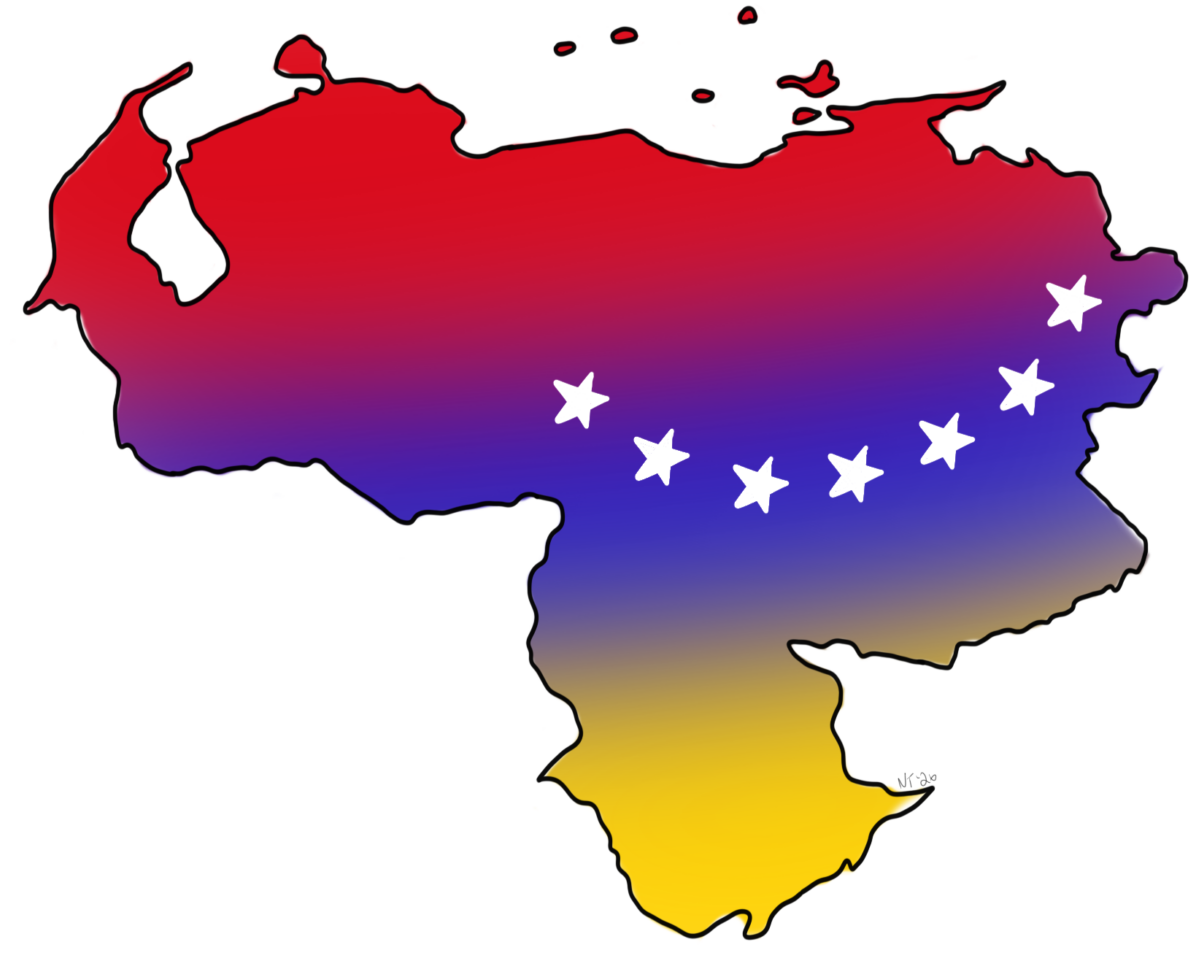
On Jan. 3, 2026, the Trump Administration captured Venezuelan dictator Nicolás Maduro and his wife, politician Cilia Flores. They are currently both imprisoned in a New York City jail. Here, in Bloomington-Normal, these international events have sparked political debates and conversations about the past and future of the United States and its relationship to the Venezuelan government.
Illinois Wesleyan University Professor Emeritus of History Mike Weis said that one his former students, now an attorney in Washington, D.C., first messaged to tell him of Maduro’s capture. “I admit I was not surprised that we had intervened militarily, but I was startled that it was done so swiftly,” he said. “It has only subsequently been revealed that there was no concrete plan” after the capture of Maduro, Weis said. It is unknown how the Trump administration will navigate their position in Venezuela in the coming months.
As a history professor who specialized in Latin American history, Weis provided important context to the current events in Venezuela and the potential for involvement in other countries. “At first glance,” Weis said, “this seemed like a revived imperialism of the 19th century variety.” A week after Maduro was captured, Weis reflected and saw that “the operation has more in common with the invasion of Iraq in 2003 than previous U.S. interventions in Latin America.” He said that these events could both be described as “resource wars” due to what some would describe as the true purpose for these conflicts: oil. On the question of whether President Trump may become involved in other countries, he said “meddling in Mexican affairs is as American as cherry pie and Trump is unlikely to show restraint. I’d say get ready for a bumpy ride.”
Connie Beard, Chair Emeritus and member of the executive board of the McLean County Republican Party, said that she supports the Trump Administration’s actions in Venezuela. “So far the additional steps taken by this administration in regard to Venezuela are warranted,” she said. “I would hope the desire of all Americans would be to help the people of Venezuela recover their freedom and their prosperity.” She said that while the actions President Trump has taken in Venezuela will benefit Venezuelans, they also benefit Americans by increasing domestic security from nations we compete with by returning oil refineries to American companies that were taken by the previous leader of Venezuela, Hugo Chavez.
But Patrick Cortesi, Chair of the McLean County Democrats, said the Trump administration’s actions fit “an old and obvious pattern. An unpopular president—failing on the economy and losing his grip on power at home—decides to launch a war for regime change abroad.” He also said that, in his view, Americans “don’t want to ‘run’ a foreign country while our leaders fail to improve life in this one.”
IWU political science professor William Munro raised important questions of US foreign policy. Echoing Weis’ concerns over President Trump’s next moves, Munro said, “Once you take out Maduro, what are you going to do next?”
This is a question that Munro believes the Trump administration does not have a concrete answer to at this moment. He said the move to capture Maduro was a success from a military standpoint, despite being “politically risky,” as there are many unknowns regarding President Trump’s intentions for Venezuela.
Munro said that the motivation for Trump’s actions is Venezuela’s oil, but it is not the investment that many believe it to be. American companies will have to pour in a large investment with the risk of having a small profit.
Aside from the companies that may not benefit much, Munro said that those who will lose the most from Maduro’s capture will be Venezuelans. While they suffered greatly under Maduro and many are optimistic the President’s involvement will be beneficial, Munro said that there is no indication that they are going to get into a better deal now that the US is involved.
IWU Musicology professor Adriana Ponce is Venezuelan. She shared warm childhood memories of Venezuela and the deeply ingrained sense of community she felt when she lived there. She expressed concern over the recent events. She said when she first heard the news of Maduro’s capture, she was shaken. Eventually the shock of the event wore off and left her feeling unable to “experience any level of joy whatsoever” regarding Maduro’s removal. She made it clear that while “Maduro was an authoritarian, incompetent, corrupt and an illegitimate president,” the “violation of international law and national sovereignty” are glaring issues that prevent her from feeling relieved that Maduro is no longer in power.
While most of her family has left Venezuela in recent years, her brother still lives there. Professor Ponce said that like many Venezuelans, her brother was “very happy to see Maduro go,” but he was also concerned about the way it occurred. Ponce said, “I feel trapped between two terrible situations for the country and cannot really derive much hope—maybe any hope—from the events we have witnessed in the last couple of weeks.”
