

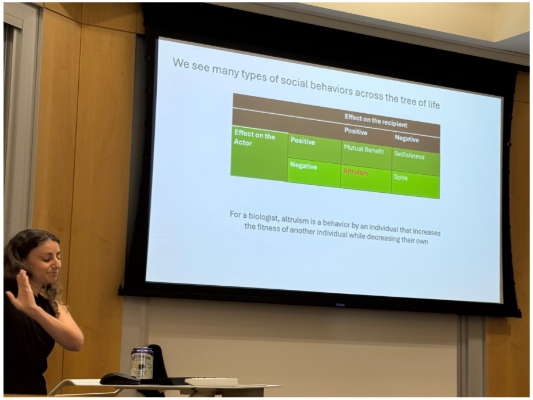
On Wednesday, September 17, the “Dialogues Across the Disciplines” speaker series welcomed Dr. Loralyn Cozy of the Illinois Wesleyan University Biology department, along with her presentation on microbiology, “Can Microbes be Altruistic?”
The speaker series was started in 2016 by Dr. James Simeone. It is sponsored by the IWU Center for the Humanities and hosts presentations once a semester that focus on interdisciplinary work being done on campus.
The event was introduced by Professor Joanne Diaz of the English department. Dr. Brian Walter of the Biology department introduced Dr. Cozy as well as her student discussant, Peyton Carlock.
Cozy, who teaches general biology as well as upper-level microbiology courses to biology and nursing students, has a focus in molecular microbiology, which was the basis of her presentation.
Cozy and Carlock’s research was inspired by a 2006 paper by Stuart West entitled “Social Evolution Theory for Microorganisms.”
The presentation examined the potential altruism in microorganisms, a relationship in which an action by one microbe would be beneficial to another but detrimental to itself. “Selfishness should win,” Cozy said.
Dr. Cozy explored the cell signaling of microbes through a lens of evolution and kinship.
“Evolution and diversity is not a linear hierarchy. Evolution happens to populations, selection happens to individuals,” Dr. Cozy said while referencing the scientific diagram, “Pedigree of Man.”
When it came to explaining how social relationships in microbes should rationally work, Cozy referenced renowned biologist Jack Meeks and his quote: “The purpose of one bacterial cell is to make 2 bacterial cells.”
The research was based on a scientific definition of altruism, versus the philosophical definition. “Altruism based on fitness, cost and gains, set(s) aside human emotion,” Cozy said.
The biologist also quoted author Kurt Vonnegut, “These are bags of chemicals.”
Dr. Cozy presented 3 examples to the contrary: Anabena, a bacteria which provides nutrients to its siblings, Bacteroids which give up their ability to divide, and Dictyostelium, a eukaryote and amoeba whose microbes work together to ensure the survival of the few.
After presenting their slideshow, Cozy and Carlock were met with questions from faculty and students in attendance, including Abby Mann of Ames Library and Dr. Edgar Lehr.
Political science professor, Greg Shaw inquired about the role of intentionality and motive in the actions of microorganisms, bringing back into question the biologists’ definition of altruism.
Humanities professors in attendance debated with Cozy and Carlock over the language of the theory, as well as whether collective actions in biological systems can or should be equated with altruism.
The “Dialogues Across the Disciplines” series will host Professor Todd Fuist in the spring.
