
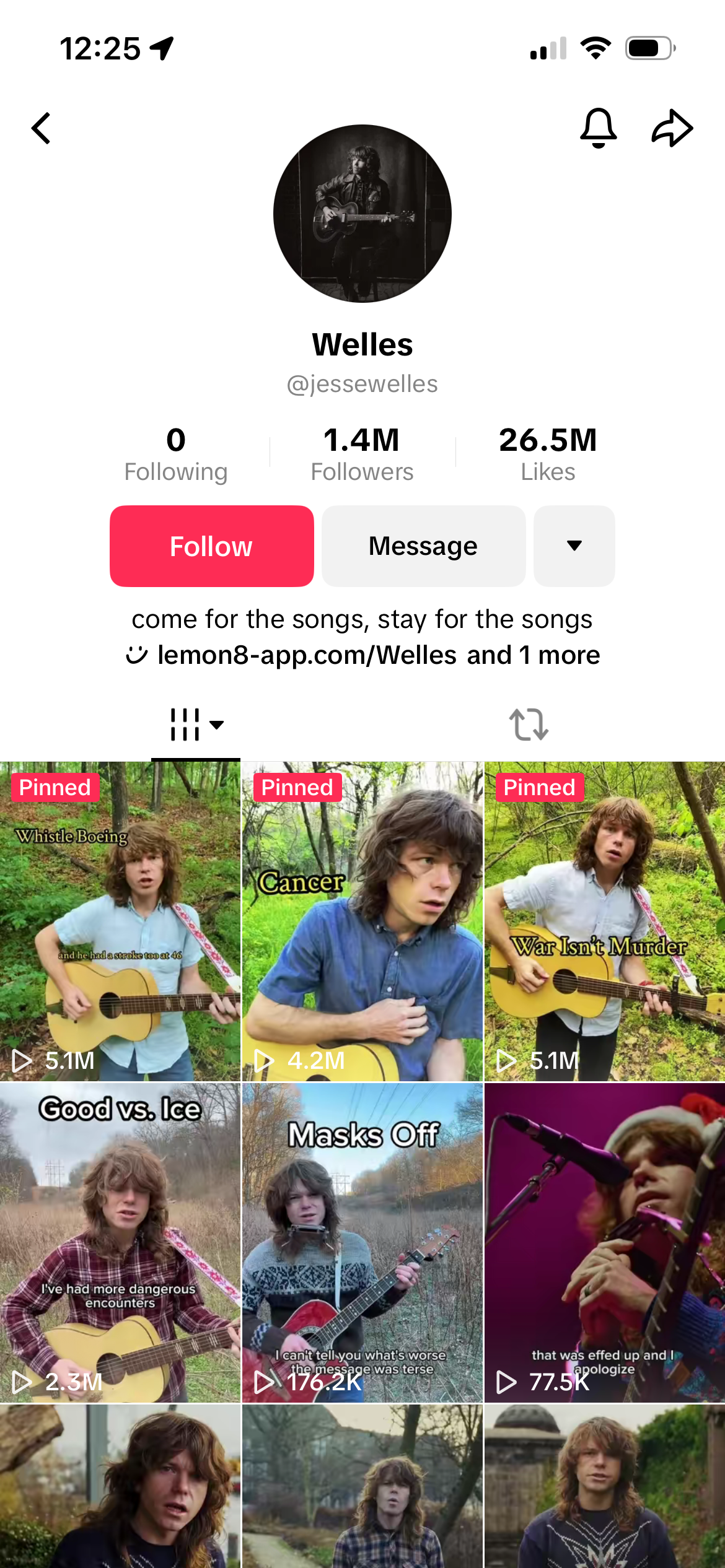
Protest music of the 21st century is most often performed in non-traditional ways, unlike the folksingers of the past that sat on a stool and strummed on a guitar in a coffeehouse. Audiences now watch performers not from a stage, but from a phone screen. Some songwriters that write about political and social issues of the day have taken to posting their songs on social media platforms, especially TikTok.
One of these singers that has gained a considerable online following is Jesse Welles.
I first heard of Welles through a post on Instagram in 2024 shortly after the CEO of United Healthcare, Brian Tompson, was murdered. In the video, he sang his topical song, “United Health,” and I was interested to find out more about this disheveled folksinger.
The song is a commentary on the U.S. healthcare system through the lens of the UnitedHealthcare company. Welles declares, “There ain’t no you in UnitedHealth, there ain’t no me in the company, there ain’t no us in the private trust, and there are hardly humans in humanity.”
Welles was a rock singer for most of his career until 2024, when he began to write topical protest songs, where he found success and internet stardom. Positive remarks and heart emojis flood the comment sections of Welles’ videos on Instagram and TikTok.
A writer for Daily Kos, a left-leaning news outlet, labeled Welles as “the Woody Guthrie for our times,” a reference to the American troubadour and writer of songs like “This Land is Your Land.”
Some even liken Welles to Bob Dylan, star of the folk revival of the 1960s who later “went electric.”
Though it is difficult to compare his songwriting to Bob Dylan, it is easy for listeners to see the parallels between the honest and raspy voice of Jesse Welles and the grit of Dylan. Many listeners already see Welles’ songwriting as deserving of some major recognition. Last year on November 19, Welles was a guest on The Late Show with Stephen Colbert.
Welles performed his song “Join ICE,” which is a satirical take and a biting criticism of people who become ICE agents. This year he is nominated for four Grammy Awards for Best Folk Album, Best Americana Performance, Best Americana Album, and Best American Roots Song Though Welles is loved and admired by his 1.4 million TikTok followers, his songs are not always met with praise. Welles was criticized for his song, “Charlie,” which is about the death of Charlie Kirk.
Some leftists and those in the protest music community found Welles’ song to have missed the nuances of the calamity.
Steven Hyden, a writer for publications like The New York Times and Rolling Stone, questioned on Substack, a social media app geared towards writers, “What, exactly, is Jesse Welles “protesting” here? He doesn’t appear interested in litigating the particulars of Charlie Kirk’s worldview or pondering the political and cultural ramifications of his murder.”
Hyden goes on to say, “Throwing up a video about a murder not even one day after it happens isn’t songwriting, it’s content creation,” and “Welles must realize that his audience is made up largely of Facebook boomers who claim they want a new Bob Dylan.”
But Welles’ recent performance at The Fillmore in San Francisco with longtime activist and folksinger Joan Baez challenges his critics’ claims that he is not a legitimate protest singer.
Together they sang his song titled “No Kings,” which was written about the No Kings protests to resist the Trump Administration’s “authoritarian power grabs,” as the organization states on their website.
Baez’s support of Welles not only showcases her confidence in Welles’ merit as a folksinger but also initiates Welles into the ranks of celebrated American songwriters.
