

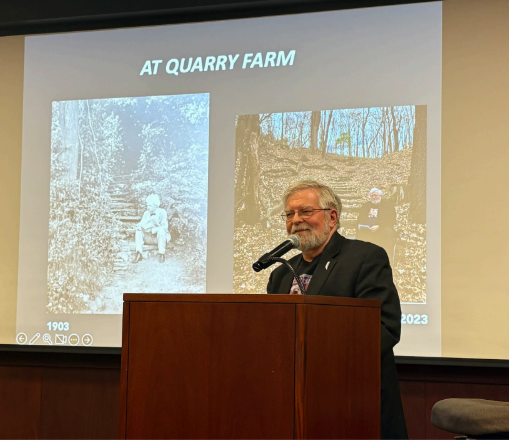
On Oct. 28, 2025, Professor James Plath read passages from his recently published book, “At Quarry Farm,” to a small audience at Bechman Auditorium in the basement of Ames Library.
“At Quarry Farm” is Plath’s eighth published scholarly book, and is titled after the Elmira, N.Y., location where author Mark Twain (Samuel Clemens) wrote many of his most famous novels, including “Adventures of Huckleberry Finn,” “The Adventures of Tom Sawyer,” and “A Connecticut Yankee in King Arthur’s Court.”
Plath wrote the first draft of the book during a two-week fellowship with The Center for Mark Twain Studies, allowing him to live in the very house the Clemens family summered in for over twenty years with his family.
Quarry Farm, which has been Elmira College’s possession since 1983, allows 11-13 scholars to stay for up to two weeks each year to work on scholarly projects.
Plath originally planned to write about how Twain was the model for professional writers, one that inspired Ernest Hemingway and John Updike (authors Plath has already written two books about.)
But his plans quickly shifted once he arrived in Elmira.
“The house had other ideas for me,” Plath said to the audience. “And I’m thinking, ‘I’m going where Twain wrote. I need to be more creative.’”
Plath’s two weeks culminated not in a book about Twain, Hemingway and Updike, but instead a creative collection of 33 poems based on short stories about the Clemens and Langdon (Twain’s wife’s family—the owners of Quarry Farm) families and Plath’s experience staying in their home.
The majority of the 15 poems Plath shared during his reading were narrative. He invited readers to step into his shoes and, in turn, step into Twain’s.
This was most apparent in “Roughing It,” a poem named after Twain’s semi-autobiographical travel novel of the same name, where Plath shares life experiences (including panning for gold and being put in jail after streaking for a bet) before pondering on how Twain may have similarly reflected on his own stories during his days at the gazebo where he often worked.
“Solitary,” one of the first poems Plath wrote after arriving at Quarry Farm, depicts the creepy, lonesome feeling you get when you stay somewhere built centuries before you were even born, isolated with no city light and all alone except for miles of wilderness.
“At night, it almost seems unendurable,” Plath bluntly said in “Entente.” “At my own daughter’s suggestion, I began talking aloud, apologizing for whatever I’d done to upend or offend, even assuring, ‘Hey, I’ll be gone in a week.’”
“Carved Stone Troughs,” one of many sonnets in “At Quarry Farm,” also puts readers in the shoes of Twain, this time as a father. It is a haunting piece about Twain outliving three of his four children.
Plath’s readings concluded with “Residuals,” which details the sensations and memories Plath could still grasp as his fellowship ended—the smells of old furniture, the pitch blackness that could only be traversed by phone-flashlight and the unnerving feelings of not being alone.
Following the reading, Plath held a book signing with students, staff, and friends who attended.
Paperback copies of “At Quarry Farm” are available for purchase for $20 on Amazon, among many of Plath’s other scholarly books.
