

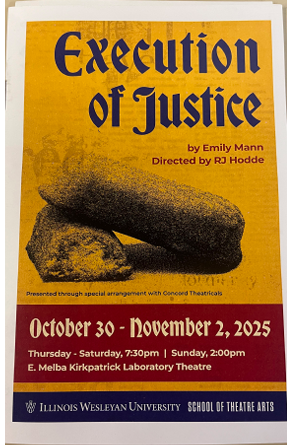
The Illinois Wesleyan School of Theater Arts closed its production of “Execution of Justice” on Sunday, Nov. 2. Written by Emily Mann and directed by professor RJ Hodde, the show follows the 1979 trial of Dan White, former member of the San Francisco Board of Supervisors who murdered San Francisco Mayor George Moscone and fellow Supervisor Harvey Milk.
The show was performed in the E. Melba Kirkpatrick Laboratory Theatre, and the smaller stage gave the audience the feeling of being inside the courtroom for the trial. The show sold out its performance on Saturday, Nov. 1.
The main part of the set was the courtroom setup, and behind the benches, podium and witness stand was a shelf that reached up to the ceiling with a projector screen on top. The TVs on the shelves showed real news footage from the trial. The show also featured voice recordings from the real trial and the reading of a letter by the real Harvey Milk.
White, played by junior Wade Schacht, resigned from his position as supervisor but later wished to repeal his resignation. When Moscone refused to reappoint him, White went to city hall with a loaded gun and shot Moscone and Milk.
The main debate of the trial was White’s sanity. Was he in his right mind? Was the murder premeditated, or the result of some mental break? Before we learned the verdict, Schacht’s performance had audiences believing both.
Schacht seemed to change White’s demeanor depending on who was on the stand. When the prosecution spoke, he sat silently in his chair, looking every bit the cold-blooded killer we were told he was. When the defense spoke, he portrayed White’s hysteria perfectly, almost enough to make you feel sorry for him.
Schacht’s performance was captivating enough to make you sympathetic towards White, but the actor and the character are very different.
“Wade is one of the most accepting people I have ever met and handled the role with incredible respect,” said sophomore Shawn Adleman. He said that Schacht regularly checked in with the cast to make sure everyone felt comfortable and respected, even in scenes where White used anti-gay slurs.
Milk was the first openly gay elected official in the country, and White was notably conservative. White’s homophobic stances took a lot of the show’s focus, and the show asked us to think about what happens when people are “pushed to the wall.”
Adelman played Milk’s friend, a character who represented the collective pain and hope of the gay community. One of the first times we really heard from Adelman’s character, he told the audience that after Harvey died, he went into a deep depression. “I portrayed a member of the gay community who was dealing with deep loss and hopelessness, to the point of wanting to end his own life,” Adleman said.
Adleman said some of his character’s dialogue was inspired by Scott Smith, Milk’s ex-boyfriend. Adleman researched Smith and Milk’s relationship and true stories of LGBTQ+ people in the 1970s to prepare for the role. “My goal was to embody the grief, resilience, and humanity of the community,” Adleman said.
The lighting also elevated the show, with a spotlight creating a dramatic effect when characters would come to the witness stand. In one powerful scene, nearly all of the lights were cut except for prop candles and a projection of thousands of candles, pulled from footage of a vigil held for Milk by San Francisco’s gay community.
The harsh lighting in the small theater made it feel even smaller, almost like the audience was trapped—just as trapped as White felt, battling two possible sentences, or like the gay community of San Francisco, trapped in a city that seemed to hate them.
“I’ve never been a part of a production with this much emotional depth, and as a gay man, I felt a strong responsibility to do the role justice,” Adleman said.
Adleman said that the storytelling in “Execution of Justice” was the reason he wanted to be an actor in the first place. “I truly believe performance is one of the best ways to spread awareness and create understanding,” Adleman said.
Adleman’s role brought a beautiful humanity to the stage, showing how grief and hope can coexist. While White’s story took the forefront of the play, Adleman’s character reminded us how the community was shaken after the murders. Their mayor was dead, and so was the icon of hope that proved progress had been made to take LGBTQ+ people out of the margins. Milk may have died, but Adleman’s character reminded us that what Milk stood for didn’t have to die with him.
The two possible verdicts that White was faced with were first-degree murder or voluntary manslaughter. Voluntary manslaughter would get a seven-year and eight-month maximum sentence. The murder charge would get White the death penalty. The final verdict: voluntary manslaughter.
White’s sentence sent the ensemble and some audience members into an outrage. One character questioned if only Moscone had died, would White have received the same sentence? Was it because Milk was gay that White only received seven years?
The audience may have left the show still asking that question, but that’s why “Execution of Justice” is still relevant today. Adleman said that we have to learn from our history to make sure it is not repeated again.
“We are living in a time when gay rights are once again being threatened, and the ability to marry whom we love is being villainized. As a society, we’re starting to take steps backward in history,” Adleman said.
That may seem bleak, but Adelman wants you to take a different sentiment away from the show. He wants the show to be inspiring, not depressing.
“I hope the audience takes away that loving who you love is not a crime. This show is a reminder that these were real people’s lives—people who fought and died for the rights we have today,” Adleman said. “I want audiences to honor those sacrifices and to leave feeling inspired to show more love and empathy rather than hate.”
