


Restrictions on gerrymandering were removed by the Supreme Court after many provisions within the Civil Rights Act of 1965 were nullified. In mid 2025, the Texas State Legislature began a mid-decade redistricting process, breaking the previous standard of states only redistricting after the decade’s census.
A census, a nationwide survey that collects demographical data, is the base for the distribution of the 435 representatives of the House, and that decides the amount of electors each state gets within the electoral college. State legislatures have historically been responsible for districting their states, however, many states including California, Hawaii, Arizona and New Jersey have implemented redistricting commissions that are independent of the state legislatures in effort to prevent gerrymandering.
Dating back to the nineteenth century, gerrymandering was when maps were created to favor one particular group over another, whether political, racial, or otherwise. Racial gerrymandering disenfranchised millions of Black people, especially in the Jim Crow era South.
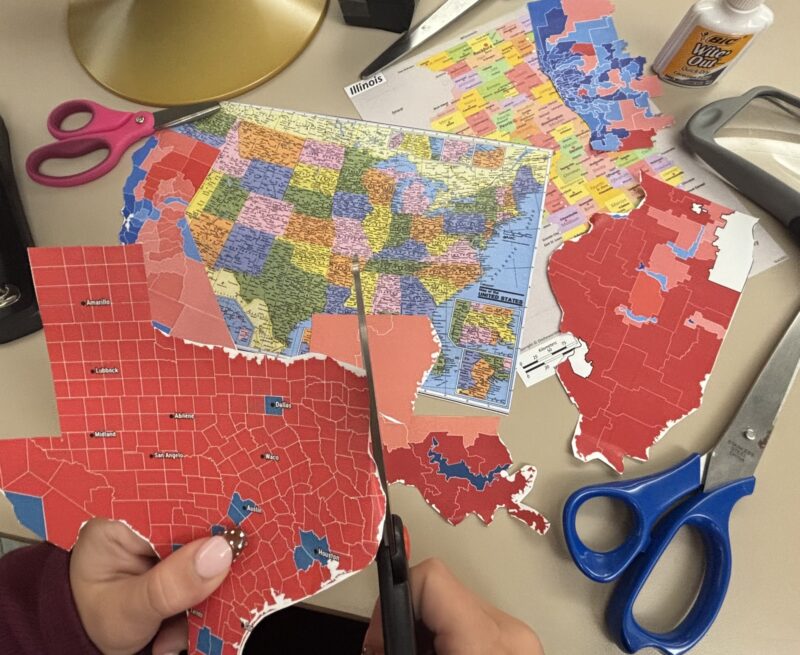
Photo: Jake Cowman and Jordan Costello
The gerrymandered Texas map will likely yield five more seats for Republicans, according to CNN; with Congress already split along party lines, small gains will make a big impact. Other republican states have followed suit, redrawing their maps in the middle of the decade.
The issue of gerrymandering spread with California redrawing their map in order to obtain five more Democratic seats, according to the SCOTUS.
Louisiana faced legal challenges when it implemented its congressional map after the 2020 census, which created five Republican districts and one Democratic. The US Circuit Court of appeals found in Robinson v. Landry that the map was in violation of the Civil rights act of 1965, and a racial gerrymander. African Americans make up roughly 30% of the population, their voting power should reflect more than just one-sixth of the representation to be in accordance with the law.
A court order demanded a new map be drawn to reflect the state’s demographics. This new map was challenged in court, and escalated to the Supreme Court where it was argued in Louisiana v. Callais that race should not play any role in districting decisions. The court agreed in their decision on April 29th.
This decision nullified major provisions of the Civil Rights act of 1965, and the court broke precedent by sending their decision down to the circuit courts, making an exception to the 32 day rule that allows for appeal.
The Supreme Court decision effectively makes it so political gerrymandering remains legal, but racial gerrymandering both in the favor or to the disadvantage of minorities as illegal, and race cannot be taken into consideration for districting processes. To overturn maps that disadvantage minorities, the intention of the map architects needs to be proven, rather than the effects of the map itself.
Racial gerrymandering has been indistinguishable from political gerrymandering, as congruency has been found between race and political affiliation.
There are two methods central to gerrymandering, packing and cracking. Packing is a map that concentrates an opposing group in one or a few districts, while cracking is the diluting of an opposing group into districts that will have a small majority in favor of the group drawing the map. These two methods can be used simultaneously to create maps that sway election results.
Many states are moving forward with new maps, including Florida, Texas, Utah, and California. Republicans likely added anywhere from ten to fifteen seats through the new maps, while democrats only added six through CA and UT.
