


A new class,“Food, Culture and Society,” taught by Carolyn Nadeau was introduced to the IWU course catalog this semester. Students taking the class are not required to have any food-related career goals, only an interest in food and its effects on the world.
Nadeau, chair of the world languages department, said that the class consists of five units throughout the semester, each focusing on a different aspect of how food, culture and identity interact.
The first unit of the class focuses on the foundational ideas of how food, culture and society are interlinked. During this unit, students made Cuban Bread from scratch, a historical dish that encompasses the deep connection between food and culture. Other dishes students will make in the future include fried dough, Thanksgiving gravy, and a recipe from the Medieval period.
The class is taught in the Petrick Idea Center’s new culinary area. The kitchen room has four stations, each with their own equipment and stovetops where four students work. Nadeau said that the group work at the kitchen stations leads to the students being “conscious of the collaboration and how it’s important to talk out who’s gonna do what, because they don’t have all afternoon.”
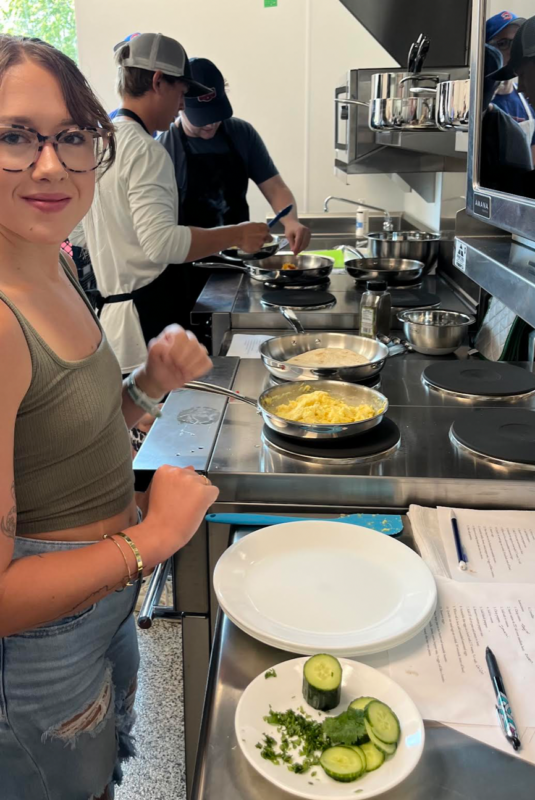
Nadeau’s class, “Food, Culture, and Society” in the Idea Center. Photo: Lola Zuro
Nadeau said that the class will go on two field trips during the semester. Students will take a trip to the Midwest Food Bank, an institution that distributes food to anyone in need. Nadeau said that “semi-trucks from states all around us come and drive up through their warehouse, load up, and then go distribute the food to different places.”
The second field trip will be to the School Street Food Pantry. Nadeau said that this building “is set up like a grocery store,” for anyone who cannot afford food to come and fill up their bag with food products – for free.
“Having a strong experiential component is a benefit to expanding ways of learning,” Nadeau said. By physically attending and examining the food pantries, students will learn in a much more profound way that would not be possible through having a traditional lecture based class.
Nadeau said that “people often take food for granted.” This rings true for college students in the midst of the semester as we hurriedly have a bite to eat before running to class, without sparing one thought to the significance of the food we are eating. “People don’t consider its importance on many different levels; it is a huge part of people’s identity and culture.”
One of the students in Nadeau’s class, senior Anna Laudeman, said that the class has helped her understand that food “is not just nutrients for the body; it also tells a story.”
Senior Luke Alberstett, a student in Nadeau’s class, said that “The Petrick Idea Center’s kitchen is well equipped, and so far we have not really been faced with any drawbacks of the space or the items it contains.” Alberstett said that has loved learning about how food “moves beyond sustenance to signify social themes like tradition.”
Alberstatt also said with “Nadeau having an extensive background in Spanish education, this class has actually provided me with a unique opportunity as a Spanish minor to focus my individual papers on latin american dishes and food culture.”
Nadeau said that through this class, students will take a step back and realize that “food and eating are not just biological needs,” instead, they are catalysts for developing societies, cultures, and identities.
