

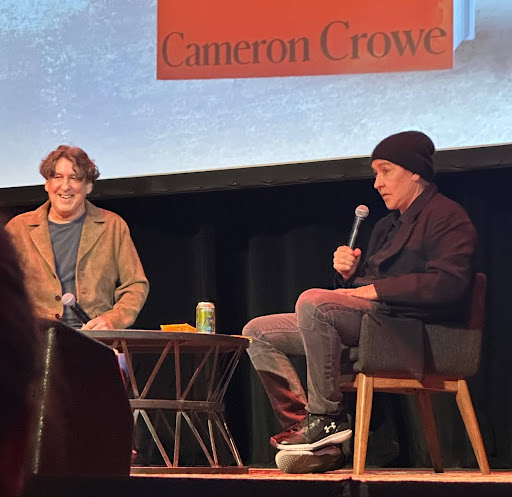
“The Uncool” is a brand new, tell-all memoir of Cameron Crowe’s journey into the world of rock journalism. The youngest person to write for Rolling Stone Magazine at 15, Crow’s work is for anyone who has ever felt like they don’t belong or has been labeled “uncool.”
He shares his encounters with famous rock bands like Led Zeppelin and The Who, but also people such as singer Joni Mitchell and the mercurial figure, David Bowie. He also sheds light on the making of his celebrated movies like Almost Famous and Jerry Maguire. Crowe is currently on a book tour throughout the US.
Alice Crowe, his mother, is a central figure in his memoir. He imparts her wisdom throughout the book to demonstrate how her worldly advice shaped him.

Photo: Ellie McEnery
“Seek out heroes and role models. Most will not disappoint you,” she’s quoted in his book. I was delighted to find truth in Alice Crowe’s words when I got the chance to meet her son.
Humility is the overwhelming feeling I felt when I had the chance to meet Cameron Crowe. He was soft-spoken and gracious when he talked one-on-one to his fans in Chicago, one of the many stops on his book tour. In Chicago on Nov. 1, John Cusack joined Crowe onstage as the moderator of a discussion about his memoir.
Cusack is an actor famous for his roles in “Sixteen Candles”and “Say Anything,” a film written and directed by Crowe. In the beginning of the discussion, the audience applauded energetically as Cusack and Crowe fawned over their love for Chicago.
Crowe went on to read an excerpt from his memoir. He told of how he almost lost a chance to write a cover story for Rolling Stone about the Allman Brothers Band when the lead singer, Gregg Allman, confiscated his recordings of their interviews.
Though Allman later returned the tapes, it was clear Crowe still felt the pain of the possible failure to produce an article for Rolling Stone, but there was also another layer of emotion for Crowe.
He seemed nervous as he began to read. His voice was shaky. It was evident as he told these stories to wide-eyed fans that the experiences he now read aloud shaped his life in very significant ways. All his life Crowe has been a fan of rock musicians.
He followed them on tour and listened to their stories. But in this auditorium, these were his own fans, and he now told his own story. The audience was hanging on every word.
Crowe talked about the underlying themes of his films. He said that he writes his characters to be “warriors for optimism” but he told the audience that does not mean leaving out integral human emotions.
Crowe’s movies, like “Say Anything,” where Cusack plays the main character, are masterclasses in writing multifaceted characters. Crowe said that when he worked with Cusack on the movie, they sought to show a realistic portrayal of human behavior in Cusack’s character, Lloyd Dobler, by “keeping the darkness in and keeping the sadness in…but blazing forward” with optimism.
Towards the end, they opened the discussion to the audience and allowed questions. People walked out into the center aisle of the auditorium as if they were on a pilgrimage to a sacred site.
Each person who gathered the courage to ask a question of Crowe or Cusack began with a heartfelt statement about how Crowe’s influential journalism or movies shaped their life in some way. Crowe responded with a genuine smile and a heartfelt “thank you for the question” each time someone reached the microphone with a query, and then he dished out the advice or a candid answer to their question.
He ended the discussion with advice for journalists and filmmakers. Crowe acknowledged the difficulty that journalists are now facing and his humble nature was revealed once again as he said, “if one or two people read this book that I wrote and realize that it’s ok to be a journalist, that pendulum is going to swing back, hopefully where it is even appreciated more, but I wave the flag for journalism.”
